
Product

CCS Busbar Laser Welding Line for Battery PACK Production
- Product description
-
- Commodity name: CCS Busbar Laser Welding Line for Battery PACK Production
The CCS Laser Welding & Assembly Line is an ultra-precision automation cell specifically engineered for attaching FPC/PCB-based flexible busbar arrays to prismatic battery poles. Integrating “Wobble” galvo-laser technology with millisecond-response electrical continuity testing, it guarantees flawless power transmission channels with near-zero contact resistance.
1. Equipment Overview
The CCS busbar laser welding line is used in battery module and PACK assembly for prismatic battery projects. It supports busbar positioning, fixture design, laser welding, weld inspection, and traceability data recording. The line can be integrated into EV or ESS PACK production according to cell format, busbar material, welding requirements, quality inspection method, and MES needs.
Huiyao Laser’s CCS Assembly Line is built to prevent this. We’ve replaced standard point-and-shoot laser mechanics with High-Frequency Active Beam Oscillation (Wobble Welding). By manipulating the laser melt pool dynamically, we can penetrate deep into dissimilar metals (Al-Cu) without burning the delicate Kapton/polyimide substrates of the FPC.
Supported by inline 3D AOI and 4-wire Kelvin electrical contact testing, this line refuses to let a bad weld reach the next stage of assembly.
Key Configuration Items
Item What to confirm Busbar material Copper, aluminum, or project-specific material Welding method Laser welding configuration and process requirement Fixture Positioning and clamping design for stable welding Positioning accuracy Required alignment before welding Inspection Weld appearance, position, and quality inspection method Traceability Welding parameter recording and MES data binding Where CCS busbar welding fits in PACK assembly
CCS busbar welding is usually connected with module assembly, PACK assembly, and electrical connection processes. It should be designed together with fixture, positioning, inspection, and traceability requirements.
Weld quality risks to check before buying equipment
Buyers should confirm welding stability, spatter control, thermal impact, busbar positioning, fixture repeatability, and inspection method before confirming the final equipment solution.
• EV Prismatic Battery Module PACK Assembly Line
• ESS Prismatic Battery Module PACK Assembly Line
2. Key Processes and Modules
2.1 3D Vision Pre-Alignment
- Function: Prior to firing, an inline 3D camera maps the precise XYZ topography of every individual pole piece. The software compensates for cumulative stacking tolerances in real-time, adjusting the laser galvo mirror trajectory by microns.
2.2 Wobble Laser Welding Station
- Function: Welds the CCS tabs (typically Aluminum/Copper) directly to the battery poles. The oscillating beam expands the intermetallic compound (IMC) layer without increasing penetration depth, ensuring a massive, tear-resistant conductive bridge.
- Specifications:
- Method: Single-mode Fiber Laser via Galvo Scanner
- Freq/Amplitude: Fully programmable wobble paths (Infinity, Circle, Spiral)
- Speed: 50–250 mm/s
2.3 Post-Weld AOI (Automated Optical Inspection)
- Function: A ring-lit camera instantly photographs the completed seam. Machine learning algorithms flag porosity, insufficient weld width, spatter, and discoloration.
2.4 Electrical Continuity & Kelvin Testing
- Function: Probes lower onto the busbar array to perform a 4-wire Kelvin resistance check, completely isolating the test-lead resistance to measure the pure micro-ohm resistance of the welded joint itself.
3. Production Line Specifications
Parameter
Specification
Applicable Components
FPC-based CCS, PCB-based CCS, Wire-harness CCS
Positioning Accuracy
± 0.05 mm
First-Pass Weld Yield
≥ 99.5%
AOI Defect Recognition
≥ 98.0%
Tested Resistance Limit
Programmable (typically < 0.5 mΩ per joint)
4. Frequently Asked Questions (FAQ)
Q: FPC substrates are highly sensitive to heat. How do you prevent burning the plastic film during welding?
A: This is exactly why we use Wobble Laser technology. By rapidly sweeping a concentrated beam over a wider area, we drastically lower the localized heat input (thermal footprint) while still achieving metallurgical melting of the metal tab, keeping the FPC polyimide completely safe.Q: Can the electrical testing station feed resistance data back into the welding algorithm?
A: Yes. If the Kelvin testing detects a slight upward drift in contact resistance across a batch (indicating possible optical lens contamination or material variation), the MES can automatically alert the operator or incrementally adjust laser power parameters to compensate.Q: Does the system handle both Aluminum-to-Aluminum and Copper-to-Aluminum joints?
A: Yes. The laser source and focal depth are programmable. Dissimilar material welding (Cu-Al) utilizes specific spiral scan paths designed to properly mix the metals without creating brittle intermetallic zones.
Key words:
Get a Free Quote
To help our engineers respond quickly, please include your cell format, module or PACK dimensions, target output, required stations, welding material, testing scope, automation level, destination country, and project stage.
Series of Products

The Huiyao Laser Cell OCV Testing & Sorting Machine is a critical component for ensuring the quality and consistency of prismatic battery modules. This semi-automatic station is designed to accurately measure the Open Circuit Voltage (OCV), AC Internal Resistance (ACIR), and polarity of individual cells *before* they enter the main assembly line. By sorting cells into precise groups based on these parameters, it guarantees module balancing, safety, and optimal performance.

The Huiyao Laser Pneumatic Stacking & Pressing Machine is a high-precision, semi-automatic station designed for the flexible assembly of prismatic battery modules. It ensures optimal cell compression and alignment during the manual stacking process, which is critical for module durability, performance, and safety. This unit is ideal for R&D, prototyping, and small-batch production environments where process flexibility and precise pressure control are paramount.
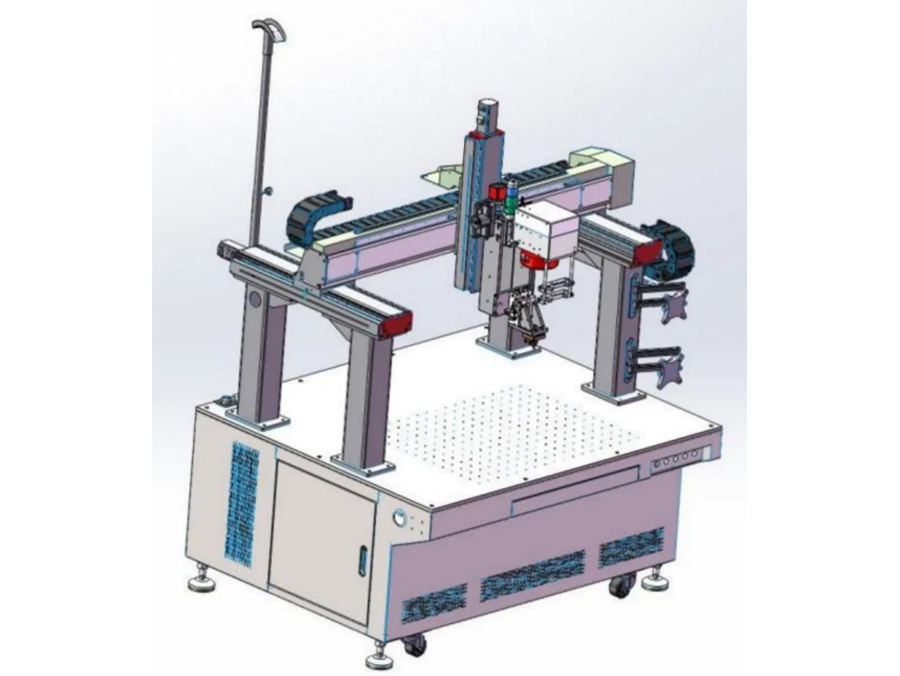
Huiyao Laser is a leading battery laser welding machine manufacturer offering professional battery pack and battery module welding solutions for many fields, such as energy storage systems of research and development machines, as well as complete assembly lines for module and battery pack production.
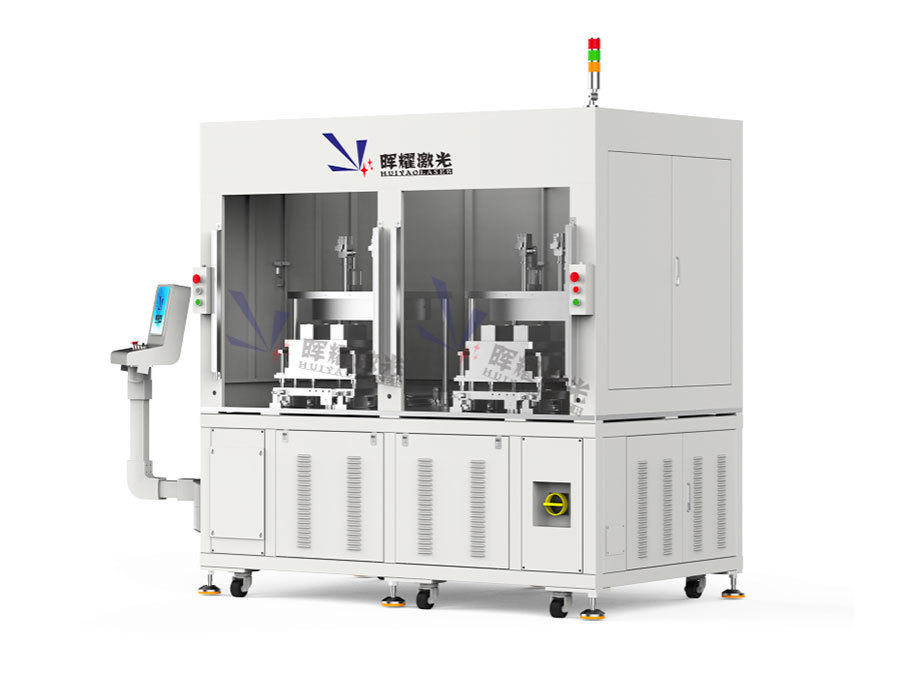
Battery Top Cap Welding Equipment
Precise welding of top caps onto battery cases, ensuring airtight sealing and electrical connectivity for prismatic and pouch batteries.
FAQ

undefined